
Speed Post News Network
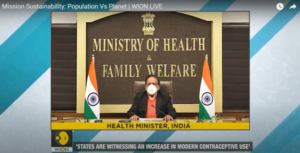
New Delhi : Union Health and Family Welfare Minister Dr Harsh Vardhan on February 20, 2021, participated at WION and Zee Media’s ‘Population versus Planet’ Conference which is a part of its year-long campaign called ‘Mission Sustainability: Population Vs Planet’.
This e-conclave marking the campaign’s launch will host deliberations between policy experts, demographic researchers & academicians on socially important themes like population stabilisation, empowering women and youth through education among various others as the world population witnesses an increase from 1 billion in the year 1800 to 7.8 billion today.
Dr said, “More people require more resources and as the population increases, the earth’s resources deplete.The population boom has been affecting the planet and the human race in many adverse ways. People in developing countries like India feel the impact of environmental problems more acutely.”
He spoke on the exhaustive efforts undertaken by India to encourage the adoption of family planning: India was one of the first countries in the world to formulate a National Family Planning Programme way back in 1952 which was later expanded to cover maternal and child health as well as adolescent health and nutrition and has taken giant strides in spreading awareness and enhancing adoption of family planning techniques while also ensuring healthier lives for its citizens.Although India’s population has increased from 36 crore in 1951 to 121.02 crore in 2011, the country has witnessed significant decline in both fertility and mortality; the crude birth rate which was recorded at 40.8 per 1,000 in 1951 declined to 20.0 in 2018; Total Fertility Rate (TFR) declined from 6.0 in 1951 to 2.2 in 2015-16; death rate in India declined from 7 in 2012 to 6.2 in 2018, Dr Vardhan added.
Speaking on India’s co-ordination in this regard with other developing countries, Dr Vardhan observed, “India has been an important and active member of Family Planning 2020 partnership, advancing collaborative efforts to address the policy, financing, delivery, and socio-cultural barriers to women accessing contraceptive information, services and supplies. From the time of the partnership’s initiation in 2012, India added more than 1.5 crore additional users for modern contraceptives thereby increasing the modern contraceptive use to 55%.”
He also reminded that the Partnership helped India add two new contraceptives : the Injectable Medroxy Progesterone Acetate (MPA) and Centchroman in the National contraceptive basket while the total allocation for Family Planning during this period was to the tune of 3 billion USD.
On the achievements of the ambitious and overarching Mission Parivar Vikas launched in 2016, Dr Vardhan stated, “Family Planning Logistics Management and Information system was developed under the Digital India initiative for ensuring last mile availability of the contraceptives. Strengthening post pregnancy contraception with more than 10 million pregnant women benefiting through Post-Partum Intra-Uterine Contraceptive Device (PPIUCD) and improving quality remained the central tenets of the programme. As a result of our persistent efforts on three key fronts of Supplies, Services and Information, India was able to provide modern contraceptive access to 14.2 Crore beneficiaries and thus averting 5.6 Crore unintended pregnancies, 18.6 lakh unsafe abortion, and 30 thousand maternal deaths in 2019.”
He also shared insights from the recent National Family Health Survey 5 that bolsters India’s remarkable achievements in Family Planning- 20 out of 22 States surveyed so far have shown an increase in modern contraceptive use and 21 showing a decline in unmet needs for contraception while 19 of them have shown a decline in fertility. India is on the verge of achieving the replacement Total Fertility Rate with 28 out of 36 states & UTs having already achieved the replacement Total fertility rate of 2.1, Dr Vardhan said, according to a PIB release.
Dr Vardhan said, “Population projection for India and States 2011-2036, released in July 2020, indicates that the Total Fertility Rate (TFR) is expected to decline from 2.37 during 2011-2015 to 1.73 during 2031-35. The youth population in the age group of 15-24 years is projected to decline from 233 million in 2011 to 227 million in 2036. However, the proportion of the working age population is expected to increase from from 61% in 2011 to 65% in 2036.India is adding 12 million people to the working age population each year.”