
Speed Post News Network
New Delhi : Defence Minister Rajnath Singh visited Defence Services Staff College (DSSC), Wellington, Nilgiris District, Tamil Nadu, on August 28-29, 2021. He was given a detailed update on the professional military education being imparted at DSSC. He appreciated the transformative changes made in the training of the young officers from India and aboard at the Institute and aligning the professional military education imparted to them to deal with the emerging challenges to national security.
Rajnath also interacted with the officers of Armed Forces. Chief of Army Staff, General Manoj Mukund Naravane, and Lieutenant General MJS Kahlon were present on the occasion.
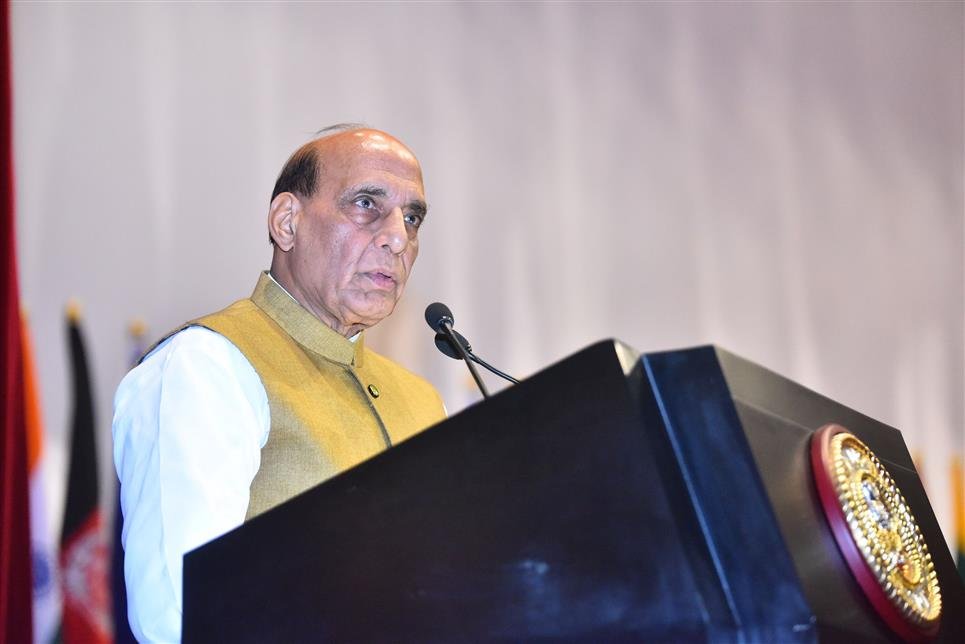
Delivering a keynote address to the 77th Staff Course, Rajnath said India is ready to face the changing security dynamics of the world due to the reforms taken by the Government, emphasising that the Armed Forces need to be fully equipped and prepared at all times. “We will continue to strengthen our military and ensure we are a step ahead to deal with any challenges arising out of the changing global security environment,” he added, according to a PIB release.
Listing out some of these reforms and describing them as those for the future, the Defence Minister said the appointment of Chief of Defence Staff (CDS) and setting up of Department of Military Affairs will go a long way in continuously bolstering the security infrastructure. “The decisions have directly linked our Armed Forces to governance as they now have direct involvement in all processes. The appointment of CDS has provided stability to the Joint Chiefs of Staff Committee as now there is a permanent and single point advisor to the government on important issues of defence and security,” he said.
On the creation of Joint Commands, Rajnath termed the decision as another major structural reform, the progress of which is moving rapidly, he said. “With the formation of Integrated Theater Commands, Armed Forces will have to develop Integrated Operational Concepts and Doctrines to fight jointly. I think DSSC can prove to be a good platform for brainstorming on this issue,” he added.
Rajnath also spoke about renaming Master General of Ordinance into Master General of Sustenance and consideration of ‘Integrated Battle Groups (IBGs)’ that will pave way for quicker decision making. “Integrated battle groups will be new groups to fight unified against the enemies. The idea of ‘Tour of Duty’ will turn into a game changing reform in the future making the Armed Forces more agile. Permanent commission for women officers in defence is a step to increase the role of women in national security,” he said.
To achieve ‘AatmaNirbhar Abhiyan’ as envisioned by PM Narendra Modi, the Defence Minister said several steps have been taken to promote self-reliance in defence manufacturing. They include setting up of Defence Industrial Corridors in Uttar Pradesh & Tamil Nadu; notifying two Positive Indigenisation Lists; launch of Defence Acquisition Procedure (DAP) 2020, and transfer of technology free of cost from Defence Research & Development Organisation, and unveiling of Innovation for Defence Excellence (iDEX) to encourage innovation and technology development in defence.
Highlighting the role of Hindustan Aeronautics Limited, Rajnath said HAL has been given a one-time order of about Rs 50,000 crore from the Armed Forces in addition to the export orders. The percentage of domestic procurement in the fund allocated for defence modernisation has been increased to 64.09 per cent, he said.
On the modernisation of Armed Forces, Rajnath said the induction of Rafale ended the long wait for Next Generation Aircraft. He added that Arjun Main Battle Tank, Light Utility Helicopter, developing counter measure systems for Armored Fighting Vehicles, and modernisation of Air Defence guns, are other steps taken to modernise our military.
Terming the situation in Afghanistan as challenging, Rajnath said the changing equations have forced every country to think on its strategy. “QUAD, a group of India, Australia, America, and Japan, has been formed in this background,” he added. He stressed on the need to view every dimension of national security in one frame in this new era and expressed hope that DSSC will train and equip the future officers of the Armed Forces to deal with these challenges.
Rajnath also asserted that India, despite its capabilities, has never attacked any country till date and has always considered the whole world as its family.
On the 2020 Galwan Valley incident, Rajnath said the unilateral attempt to change the status-quo at the Northern border was also dealt with a new dynamic. “Our soldiers displayed bravery as well as restraint, when required, to thwart enemy plans,” he said lauding the exemplary courage of the Indian Army personnel, under the leadership of Chief of Army Staff General M M Naravane, for effectively dealing with the situation at the Northern border.