
Speed Post News Network
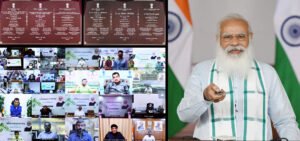
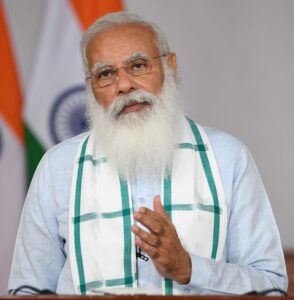
New Delhi : Prime Minister Narendra Modi on June 5, 2021, addressed the World Environment Day event, jointly organized by the Ministry of Petroleum & Natural Gas and the Ministry of Environment, Forest and Climate Change, through a video conference. During the event, the PM interacted with a farmer from Pune, Maharashtra, who shared his experience of organic farming and use of biofuel in agriculture.
The Prime Minister released the “Report of the Expert Committee on Roadmap for ethanol blending in India 2020-2025”. He also launched the ambitious E-100 pilot project at Pune for the production and distribution of ethanol across the country. The theme for this year’s event is ‘promotion of biofuels for a better environment’. Union Cabinet Ministers: Nitin Gadkari, Narendra Singh Tomar, Prakash Javadekar, Piyush Goyal, and Dharmendra Pradhan, were also present on the occasion.
Speaking on the occasion, the Prime Minister said that India has taken another leap by releasing a detailed roadmap for the development of the ethanol sector on the occasion of World Environment Day. He said that ethanol has become one of the major priorities of 21st century India. He said that the focus on ethanol is having a better impact on the environment as well as on the lives of farmers and added that the Government has resolved to meet the target of 20 percent ethanol blending in petrol by 2025. Earlier, the resolve was to achieve the target by 2030 which is now preponed by 5 years.
The PM said that till 2014, on an average, only 1.5 percent of ethanol could be blended in India which has now reached about 8.5 percent. In 2013-14, about 38 crore liters of ethanol were purchased in the country which has now grown to more than 320 crore liters. He said that a large part of this eightfold increase in ethanol procurement has benefitted the sugarcane farmers of the country, according to a PIB release.
The PM remarked that the 21st century India can get energy only from the modern thinking and modern policies. He said today, a lot of emphasis is being laid on building the necessary infrastructure for the production and purchase of ethanol in the country. Most of the ethanol manufacturing units are mostly concentrated in 4-5 states where sugar production is high but now Foodgrain Based Distilleries are being established to expand this to the whole country. Modern technology based plants are also being set up in the country to make ethanol from agricultural waste.
PM Modi said that India is a strong proponent of climate justice and is moving ahead with a lofty global vision like the founding of International Solar Alliance for realising the vision of ‘One Sun, One World, One Grid’ and the Coalition for Disaster Resilient Infrastructure initiative. He noted India has been included in the top 10 countries of the world in the Climate Change Performance Index. He noted that our capacity for renewable energy has increased by more than 250 percent in the last 6-7 years. India is today among the top 5 countries of the world in terms of installed renewable energy capacity. The capacity of solar energy has increased by about 15 times in the last 6 years, he added.
The PM said that today the common man of the country has joined and leading the Pro-Environment Campaign like avoiding single use plastic, beach cleaning or Swachh Bharat. He added that the impact of giving more than 37 crore LED bulbs and more than 23 lakh Energy Efficient Fans are not discussed often. He said similarly, by providing free gas connections under the Ujjwala scheme, electricity connections under Saubhagya scheme, to crores of poor, their dependence on wood has greatly reduced. Apart from reducing pollution, it has also helped a lot in improving the health and strengthening environmental protection. He said India is setting an example to the world that it is not necessary to stop development for protecting the environment.
The PM said India is working with a holistic approach through the National Clean Air Plan to curb air pollution. He said the work on waterways and multimodal connectivity will not only strengthen the mission of green transport, but also improve the logistics efficiency of the country. Today, the service of metro rail in the country has increased from 5 cities to 18 cities which has helped in reducing the use of personal vehicles. The Prime Minister said that before 2014, only 7 airports had a solar power facility, whereas today this number has increased to more than 50.
The Prime Minister spoke about a project which is underway to develop Kevadiya as an electric vehicle city. He said necessary infrastructure is being made available so that only battery based buses, two-wheeler, four-wheeler will run in Kevadiya in future. He said the water cycle is also directly related to climate change and imbalance in the water cycle will directly affect water security.On one hand, every household is being connected with pipes, while on the other hand, the focus is on raising the groundwater level through campaigns like Atal Bhujal Yojana and Catch the Rain, he said.
The Prime Minister said a lot of work has been done in the last few years on the Kachra to Kanchan campaign and now it is being taken forward very fast in mission mode. The action plan related to this, which will have all the regulatory and development related aspects, will be implemented in the coming months.